 Copyright
© 2007 Road to Jacksonville
Copyright
© 2007 Road to Jacksonville
Webmaster : Patrice GROS
Tous droits reservés.
Design par Zion pour
Kitgrafik.com
HENRY
PAUL
On The Outlaws, Blackhawk, and a Lifetime of Great
Music
by Michael Buffalo Smith
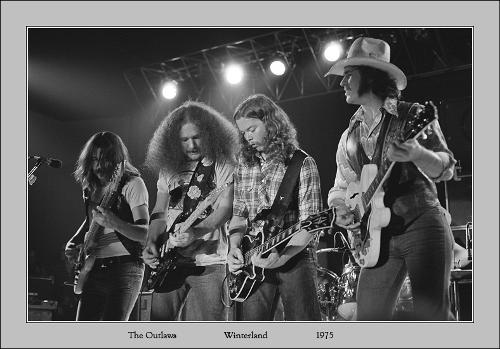
He was a member of the legendary Southern Rock band The Outlaws, He
also scored big with his own Henry Paul Band, and as a member of Top 40 country
band Blackhawk. Now, Henry Paul is touring and recording with a new set of
Outlaws, as well as assembling a new Blackhawk record that will feature some
of his classic rock pals. Life is good for the Florida rocker. We caught up
with Henry for this long awaited GRITZ interview.
I know you were born in New York. You moved to Florida at a really young age,
right?
I was eight. I was in third grade. I’ll never forget it. It was great
man, (laughs) it was like culture shock. I mean, I come from a working family
farm that grew a thousand acres of sweet corn. We’d hire 70 migrant workers
to go into the field and care for it. When I got to Florida my parents split.
My mom packed her stuff up in her 1957 Oldsmobile and we drove down 301 to
Lakeland. I kept thinking to myself that there were going to be like indians
and natives in the jungle down there. I wasn’t that far off. (Laughs)
The obvious emotional issues on the table were large. But getting there and
being turned loose in the orange groves and the phosphate pits and the many,
many lakes and fishing - it was huge. It was also an unusual time in our country.
Segregation was front and center. Nobody was pulling punches. It was very
graphic and clear where people stood. That was a shock to me, because where
I came from we didn’tsee much of that.
Henry, who do you recall being your earliest musical influences?
Well, I remember the first record I bought was “Donna” by Richie
Valens. I got into all the novelty records of the time like “Splish Splash,”
“April Love,” “One Eyed One Horned Flying Purple People Eater”-
You know, it was like Bobby Vinton... the Elvis thing was around, but I wasn’t
into it. It was like a culture unto itself that I was not involved in. I came
in on sort of the backside of Elvis’ heyday.
As a kid I liked music. One record that was really, really big for me around
the time I was in the fifth grade was “Runaway” by Del Shannon.
I used to go around singing that, and Little Anthony & The Imperials were
some of my favorites. I remember being enamored by Little Anthony’s voice.
I was a product of the playlist. Whatever was out there was what I heard.
There was just a whole mess of it. But “Runaway” really cranked
my interest in music. It just jacked it up.
So I moved from Lakeland to Tampa in 1961, and that was a big city. Lakeland
at the time was a very small town. During my Junior High years of course “The
Twist” was huge, and all of the teen idols of the day, Bobby Vinton,
Bobby Vee, Bobby Rydell- all of the Bobbys. And I’d go to the Rexall
down the street, and they sold record albums like “Chubby Checker Meets
Bobby Rydell.” Guys with a hit song or two apiece, and they’d talk
to each other, “Hey Bobby! Hey Chubby!” (Laughs) It was really hysterical.
Were you a Beatles fan?
The Beatles hit in ‘63 and that was huge. The guys with their Gretch
guitars and high heeled black boots. It was like, wow, rock and roll can be
really cool! It can be more than sexy, it can have some attitude. The Beatles
changed the landscape in a hurry about being in a band as opposed to being
a teen star. We were all pretty rocked by that. Everybody owned that first
Beatles album and we took it to parties and played it. Somehow in there I
kind of moved into the folk music thing. Folk music was huge.I moved back
in with my dad. Things at home were going to shit. Mom was in the middle of
her second divorce and it just wasn’t fun to be around my step dad at
the time. He was a little bit weird and everybody was kind of bailing.
I bought my first guitar in the ninth grade, I was like 13, and my step brother
was already a pretty good player. I used to sit in my room and work up songs
that I liked on the radio. (Sings) “Well they’re out there having
fun, in the warm California sun.” My step brother and I would take a
bus from my house up in Kingston to mid-town, and we’d walk down to Greenwich
Village. This was around ‘65. Folk music was booming, and Hootnany was
an ABC TV show we all watched. Peter, Paul and Mary dominated the charts and
people like Gordon Lightfoot started to emerge as big stars. So I ran with
that. I went to the folk music stores and bought records by Leadbelly, Woody
Guthrie. I became a student of folk music, and I learned how to Travis pick.
I started writing songs.
In late ‘65 I ran away from my dad’;s house. I took my little Goya
gut string guitar and all of the clothes I liked in a burlap bag. I was 16
at the time, and I hitchhiked from Upstate New York to Tampa, Florida. It
took me a couple of days. But for a 16 year old kid it was a bold adventure.
I’d say so.
So I moved back in with my mom. And there was a gathering place called Boarts,
and there were some really good singers there. So i hung around there for
a few years. By 1969 I had graduated high school and I had gone to California
and hitchhiked to Woodstock from L.A. Then I moved back to Tampa but I had
made the decision that I was going to gather up all my stuff.
and move to New York. I was going to go to Greenwich Village and make a career for myself in the music business. I started to audition at all of the folk music clubs like The Gaslight, Folk City, The Bitter End - I made the rounds at these places and I got a job at The Strand book store in The Village. Don Ellis, the head of A&R at Epic at the time heard that I was around and was around and had an interesting voice, so I went and auditioned for Don, who took me down to the Columbia 55th Street Studios, and myself and a violinist from Tampa named Richard Lepps and Frank McCare all went into the studio and cut like six of my songs. Don Ellis loved it, and he asked me if I’d ever considered going to Nashville. I said no, but I’d do whatever it took to get to the next level. I was really chewed up wanting to make it. I figured if Johnny Cash could make it in the music business, I could too. (Laughs) I was pretty aggressive. At that time I got a call from my friend in Tampa who was putting a show together of folks from Tampa who had gone on to make progress in the music business and I was in that group. He was going to put a show on at the Tampa Armory. This was in 1970. and I put a band together.

I met Jim Fish through Frank McCare, my friend in Greenwich Village, and Jim
lived up in Albany. We just hit it off, and played great together and sang
harmony. We formed this band called Sienna. The bass player and sax player
, both from The Village in New Your, and Jim and myself, and we came to Florida
and Monte Yoho joined the group, that was in like ‘70 or ‘71. Then
the bass player got a case of home sickness and took off so Frank O’Keefe
joined the band, so there’s Monte and Frank and I. So we played the counterculture
card for about a year.
Hughie Thomasson was in New York playing with another folk singer at the time,
and he got home sick and came back to Florida, and he joined us. He knew Frank
and Monte from The Outlaws, the little teenage band they had that played recreation
centers and such. Then we changed our name from Sienna to The Outlaws to try
and get more bookings. We started playing in the clubs in central Florida
and Coco Beach and Billy Jones came back from Colorado and joined the band
and we were writing songs. I had become a fan of folk rock or country rock
and was into bands like Poco and The Lost Planet Airmen and New Riders of
The Purple Sage. And The Grateful Dead were producing great albums at the
time like American Beauty and Working Man’s Dead. So I tried to wrap
the Outlaws musical identity around that type of sound, and it worked. Hughie
was really adept at playing that type of music, and Monte, as a drummer was
just right for that job.So we started to catch on in Tampa, and there were
five or six bars up around the University of South Florida where we played
and became sort of the underground band. So I met this guy who wanted to manage
the band and I let him do that, and that got us in touch with a couple of
other people. We met Lynyrd Skynyrd out on the road. Ronnie Van Zant was singing
our praises to his manager and to anyone who would listen. We wound up getting
our record deal in ‘74 and the first album came out in ‘75. That’s
sort of a thumbnail sketch. We went out with that album, and then a second
and third album, and then there were problems in the group and I left the
band and started The Henry Paul Band.
Well, what would you say were the highlights of your first round with The
Outlaws?
You know, being thrust into the major league of rock, from playing arenas
to stadiums with The Stones, to Central Park with Jefferson Starship, playing
in front of literally hundreds of thousands of people. Being shoved out there
and being expected to win these people over. The pressure on the band to succeed
was huge. It was great being charged with energy from the audiences positive
reaction to your music. It included such social props as bottles of Jack Daniels
Black Label whiskey, cowboy boots, cowboy hats - the brotherhood we formed
with bands like Charlie Danielsand Marshall Tucker. The Allman Brothers were
a little bit higher up in the feeding chain, so they didn’t give back
quite so much as Charlie Daniels or Tommy and Toy Caldwell, Tommy especially
was more gracious and inviting. All of those guys but Tommy in particular,
like we were talking about the other day.
Can you run back over those thoughts on the record?
Sure. We were talking the other day about the band Cowboy. They had a record
out, and Marshall Tucker was way out there with a very, very popular record.
We were still playing clubs, we had not quite arrived. But when we played
with Marshall Tucker - we never played with Cowboy. They sort of evaporated
before e got going- but the Tucker band was huge and they embraced us, as
did The Charlie Daniels Band. David Corlew, Taz, Tommy Crain, Toy and Tommy
Caldwell, Paul Riddle especially, George McCorkle - Jerry Eubanks was more
of a jazz guy, he was on a different page sort of, but Jerry was a very nice
man, but he seemed a little more intellectual. He was a little more sophisticated.
An the singer in the band always had an agenda. But Tommy was the focal point
of that group as the gate keeper and he set the tone. He was enormously huge
in our hearts. I would say Tommy Caldwell and Charlie Daniels were the two
biggest influences on me as band leaders and as cultural icons. They were
two people who were worthy of imitation. We had this brotherhood. It was us
against the world. It was fuck L.A. Fuck the Eagles. I remember feeling it
was us and Tucker and Charlie against L.A., The Eagles and Linda Ronstadt
and Loggins and Messina. It was “The South’s Gonna Do it Again”
and “Dixie.” It was tattoos and the flag and a cultural bonding
of like minded spirits. It was going out on the bill with Tucker of Lynyrd
Skynyrd.
But Skynyrd was more punk. A little bit more rock and roll with all the fixins.
The fighting and the swagger. The Tucker band didn’t play that game.
They were men. They were fuckin’ men. They wore United States Marine
Corps tattoos. It wasn’t like “we’re in a rock band, fuck you.”
It was “we’re grown men who play the shit out of music.” I
don’t know how much older Tommy was than me, but I was not as grown up
as he was. I had not done as much as he had, not only professionally but his
stint in Southeast Asia, I mean, the boy had been all up in it. Grinderswitch
was the perineal opening band on all these tours. It was just a cultural extravaganza.
Southern Rock was sort of born from what all of that was, and The Outlaws
were probably the last band to get in on that. I mean, you can say Molly Hatchet,
but they were a totally different thing. We didn’t share with them what
we shared with Tommy and Toy and Charlie. At least I didn’t. They came
along and enjoyed significant success, and I was respectful of their success.
You learn to appreciate someone else’s success. But I didn’t embrace
it musically and culturally like I did Charlie and Tucker.
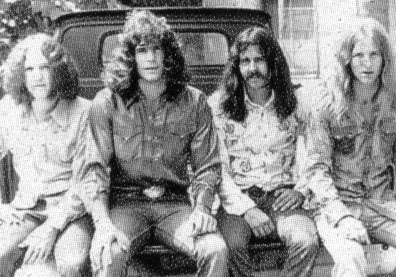
Well they were a different kind of band. I always felt Skynyrd and Hatchet
were more redneck rockers, drinking and fighting and rocking out garage style.
But The Outlaws to me, like Charlie and Tucker, and Dickey in the Allman Brothers,
were my kind of music. A mix of country and rock with a unique southern swagger.
And it was a real brotherhood.
It was learning by example. If you were embraced by someone like Tommy Caldwell
- and of course Toy was the creative core of the band, but Toy was always
in fast forward, you had to watch that movie in fast forward - but Tommy was
the voice of reason, the methodical calm, I went to Tommy’s funeral,
and they took this guitar strap of his and laid it over the casket before
they lowered it into the ground and it was the end of an era right then an
there. I went to Ronnie’s funeral too, and that was the end of an era
as well. Very emotional. The last time I saw Ronnie Van Zant alive I was playing
a show with him in Winston Salem, North Carolina and he and I were on the
bus drinking whiskey together. He was intoxicated and telling me that he was
the Prince of Dixie. I was sitting over there drinking and going, “Fuck
you. What the fuck is the Prince of Dixie?” He said that Duane Allman
was the King and he was the Prince.He had the whole thing figured out. We
got back to the hotel and were riding the elevator up and Ronnie and I were
just cranked up. We got to the top floor and the door slid open and we came
spilling out and we knocked over one of those ash trays full of sand. It was
a scene. Gene Odom was there and he said “Is everything okay here are
we cool?” And I said yeah. Ronnie went his way and I went mine and that
was the last I saw of him.
The Henry Paul Band came along, unfortunately Tommy was gone, Tucker was evaporating.
Charlie was still in business and we shared that relationship with them. Then
Hughie and I reconciled our ongoing relationship of difference to put The
Outlaws together in 1983. It was weird Hughie wanted me out of the band in
‘77 because he wanted to go in more of a rock and roll direction, and
I was sort of the country rock guy in the band. And there were conflicts between
Billy and I and Hughie, and there wasn’t a core that held us together
like the Tucker band. So Hughie thought it was a good idea for me and him
to get back together. Billy Jones was already out of the band and on a downward
spiral as far as substance abuse. Frank was not in the music business anymore.
Monte was spinning his own web. But Hughie and I continued to move forward
from ‘83 -’89 with one album called Soldier of Fortune. One odd
record. I tried to get us into the modern music scene but it was like a dog
chasing his tail. You’re either out in front or your just jerking off.
That record had “Cold Harbor” on it which I am thankful for. It
was an odd song for the record, but it turned out to be the best song on the
record. And it had “What You Don’t Do,” which I thought was
a good song, and the title track whish was an interesting melodic Hughie Thomasson
song. But we couldn’t get arrested. We were out there playing clubs for
very little money and it was a great job but it was a labor of love. We started
doing things ourselves.
Then in ‘89 I wanted to come to Nashville. I wanted to take The
Outlaws with me but Hughie didn’t want to so I went on my own and ended
up forming Blackhawk and had significant success with that band. Then Hughie
and I got back together in 2005 and I basically put Chris Anderson in. My
job was always to put the band together. I met Chris in a bar in Sarasota
and gave him a job. Randy and I played together in Blackhawk. And Dave Robbins
and I played together in the Outlaws and he got the keyboard job. And then
it was down to Dix and me and Monte and Flame. (Hughie) Then when Hughie died,
we added Billy Crain who was perfect for the job. That was huge. I had this
idea of consolidating the bands into one. Bringing John Coleman into the band
and that worked well. I always thought the two drummer thing for us was not
necessary. It was a great entertainment, but musically, Monte was enough.
So we decided to move forward as The Outlaws and we would rehearse the songs
and I would sing the shit out of them and play the damned dog crap out of
them and see if we can win over the faithful. And we were able to do that.
It was mostly on the strength of the band’s heart.
I still have a strong singing voice. Hughie’s singing voice sort of faded
with time. But mine, for whatever reason grew in strength. So I was able to
sing his songs with authority and with this enormous, earth shattering volume.
“Ghost Riders in the Sky” is a powerful moment in the show, as is
“Hurry Sundown,” which Hughie wrote is in the clouds. It is another
high point on the show. The band is really, really good. We have re-energized
and rejuvenated the classic Outlaws songs, and now we have really locked into
the creative process of writing a new album. And to write a new Outlaws album
without Hughie is ... novel. But we have a great band and the spirit of the
Outlaws is more than alive. We are being respectful and sensitive to the band’s
history, but we have an obligation to write new songs and move forward. Right
now I think it’ important to redefine who we are through the songs.
How close is the album to being done?
Oh, we’re just halfway done writing it. But nowadays when we write a
song we go in and cut fairly complete demos on the song so we have a road
map. But the recording has not begun. We did record the greatest hits, everything
from “South Carolina” to “Green Grass and High Tides,”
and they are fucking phenomenal.
(We are interrupted by a call from Billy Crain)
Was that Billy?
Yeah. I tell you. Getting him in the band was phenomenal. If he wasn’t
in the band I don’t know where we have gone. Nobody else does what he
does at that level. Chris Anderson and him are absolutely frightening.
Billy is indeed awesome, just like his brother Tommy.
They always have been. I met them in 1973 and they were amazing then. So that’s
where we are now. The Outlaws gig these days is a labor of love. There’s
not a lot of money in it. It’s not some fat and sassy rock and roll gig
where you’re making a fortune. I am very acutely aware of the negative
crap that went on prior to the band’s formation. Most of it has gone
away. Some of it may never go away. I’m a busy guy. I don’t have
time to worry about what a few people are saying on the internet. I’m
going to do what I need to do to make a living. I have enough on my plate.
But there are key characters in the drama, especially one, and I am well aware
of them. The one guy is just an evil guy. Nobody likes him and everybody ignores
him. He spins everything. But I can see where some people said the things
they said, I understood the emotion and the perception issues that go into
making people feel they do. But long ago and far away before any of those
people knew who The Outlaws were, I know how they came to be and what my part
in it was. Not only am I entitled to move forward with a band that I was a
part of and instrumental in creating, but I have a right to do whatever I
want to do and not answer to anybody. It’s in my makeup. I’m not
interested in playing into the public opinion poles. I don’t have time
for it.
Is anything happening with the Brothers of the Southland band?
I don’t feel anything happening there. I think that was a record that
we made, and it was good, but there’s nothing happening now.
Tell me about Bo Bice.
He’s a really nice guy, and I think his affection for that great old
music is very sincere and respectful. I consider Bo an apostle of that music.
For that I am thankful. He’s a really, really nice young man. He’s
a great singer.
What else do you have cooking besides the new Outlaws record?
Well, Blackhawk. Blackhawk is perceived as a musical entity that gets lumped
in with Sawyer Brown and Diamond Rio, Lonestar and all that. But Blackhawk
is different than that. But Joe Lala from Manassas called me the other day
and I called Chris Hillman from The Byrds and Bruce Hornsby, and I am putting
together a new Blackhawk record with the guys I am playing with and these
musical guests. I think the new Blackhawk record will be great and interesting.
That record is written. But right now 100 percent of our time is devoted to
the new Outlaws record, and when we get ten or twelve tracks ready, you’ll
be the first to hear it.
I can’t wait. Well Henry, thanks for your time. Keep on making that
music we love.
Thank you, Michael.